nrodgers

About Natalie Rodgers

This author has not yet filled in any details.
So far Natalie Rodgers has created 70 blog entries.

Fiber-Reinforced Concrete 101

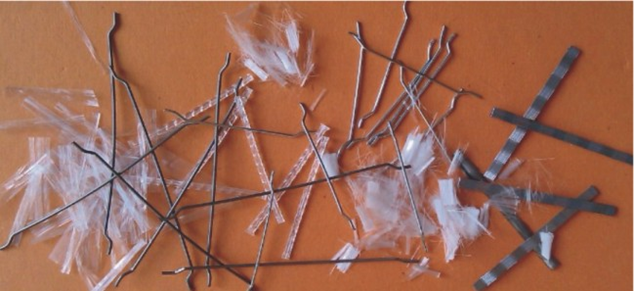
Traditional concrete has widespread usage across building and roadway construction and is known for its superior structural strength. But what if we told you that it could have even more resiliency without the need for rebar? Fiber-Reinforced Concrete (FRC) technology incorporates micro and/or macro synthetic or steel fibers into the concrete mix itself for added resistance to deterioration, as outlined and specified in ASTM C1116. What is Fiber-Reinforced Concrete? Concrete cracking is not uncommon due to drying shrinkage, structural loads or other forms of stress. The use of fibers in concrete can help mitigate age-related cracking and improve spall protection and freeze-thaw durability. Macro-synthetic fibers, sometimes referred to as structural fibers, can be “engineered to be equivalent to conventional steel reinforcing” when correctly dosed and mixed in concrete. Applications for Fiber-Reinforced Concrete Fiber-Reinforced Concrete has universal applications where strength and crack-resistance are needed, including: Vehicular uses such as roadways, bridges, parking garages, and driveways Structural walls, including with Insulated Concrete Forms (ICFs) Shotcrete for foundations Precast concrete Benefits of Fiber-Reinforced Concrete Fiber-Reinforced Concrete offers numerous short-term and long-term benefits to the building owner, contractor, and ready-mix concrete producers. Learn more here.

By |2023-05-04T13:54:01-05:00June 16, 2023|Featured, Technical|

How to Design Your Dream Custom-Built Home

There are many advantages to designing your own home. Gone are the builder-basic styles, layouts that don’t work for your family, and exteriors you can’t tell apart from your neighbors’. To help with your planning, check out these pro tips: Find the Right Property There are no limits to what you can create with a custom-built home, but the size and quality of your lot do impose restrictions. While you don’t need to have everything decided when you purchase the property, make sure you have a general idea of what you need — your architect or contractor can help with this. Also, double check zoning laws, so you don’t wind up not being able to build your dream three-stories on a residential street that only allows bungalows. Built in Pismo Beach, California, the Bluff House took advantage of Nudura ICF's design flexibility. Consider Your Lifestyle What kind of lifestyle do you want? What’s important to you? From bigger elements like smart home automation and sustainability, to smaller considerations like storage and organization, think of these when designing the layout and built-in elements. For example, if you hate shoveling, now is the time to make sure you have the shortest driveway possible. Read [...]

By |2023-05-04T13:49:16-05:00May 26, 2023|Design, Featured|

3 Reasons to Build a Disaster-Proof Home

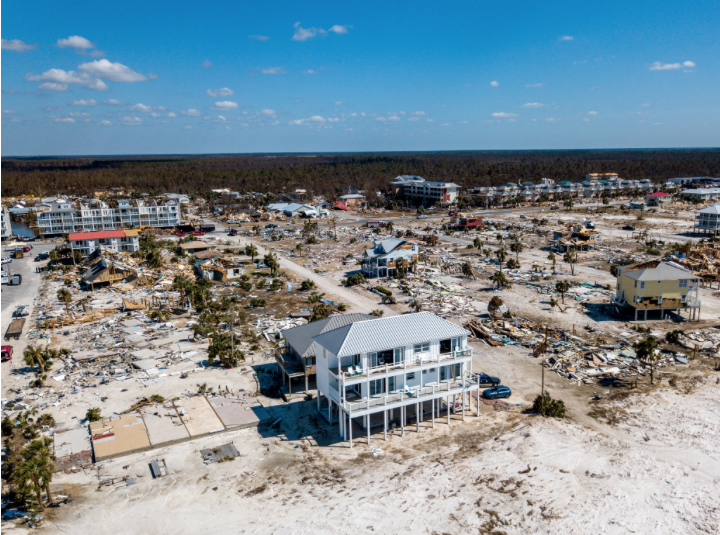
With the climate crisis creating more severe weather events across North America, having a house that can stand up to the worst nature has to offer is more important than ever. Whether it’s tornados, wildfires, floods, hurricanes, or earthquakes, you want to know that you and your family are safe and protected. This means making sure your home is built with quality products that can withstand wind, hail, fire, and more. One of the best disaster-resilient materials on the market are insulated concrete forms (ICFs) from Nudura. The ICFs can be used instead of wood for superior strength, safety, and durability against extreme weather conditions. It also offers lower utility costs over the lifespan of your home. Here are just some of the reasons to consider building your next home with disaster-resilient ICFs: Fire ProtectionConcrete is tougher and less flammable than wood, so if there is a fire, you and your family will be much safer in an ICF home. The ICF wall’s concrete core combined with non-toxic, fire retardant expanded polystyrene foam provides a fire protection rating of up to four hours. Wind ResistanceICF homes can be designed to withstand winds of up to 250 miles per hour (402 kilometers an hour), or [...]

By |2023-05-04T13:44:22-05:00May 5, 2023|Featured|

Thermal Study

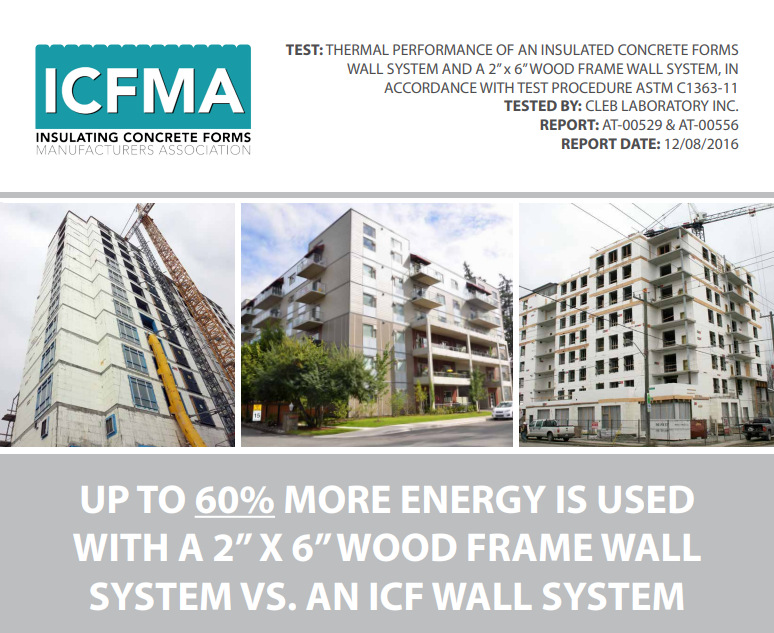
THERMAL STUDY PROVES AN INSULATING CONCRETE FORM WALL CAN ACHIEVE UP TO 60% ENERGY SAVINGS AND 58% GREATER R-VALUE/RSI FOR HOME AND BUILDING OWNERS The Insulating Concrete Forms Manufacturers Association (ICFMA) recently commissioned CLEB Laboratories (formerly known as Air-Ins Inc.) to conduct the first in a series of accredited whole wall thermal studies. This installment compared a 2” x 6” traditional insulated wood frame cavity wall to a standard 6 inch (150mm) core insulating concrete form (ICF) wall. The study was overwhelmingly revealing; confirming dramatically superior energy-efficiency performance and an overall better R-Value/RSI demonstrated by the ICF Wall assembly. Learn more here.

By |2022-12-06T14:05:23-06:00January 3, 2023|Featured|

ICFMA Members Support NRMCA Build With Strength Future Schools Summit

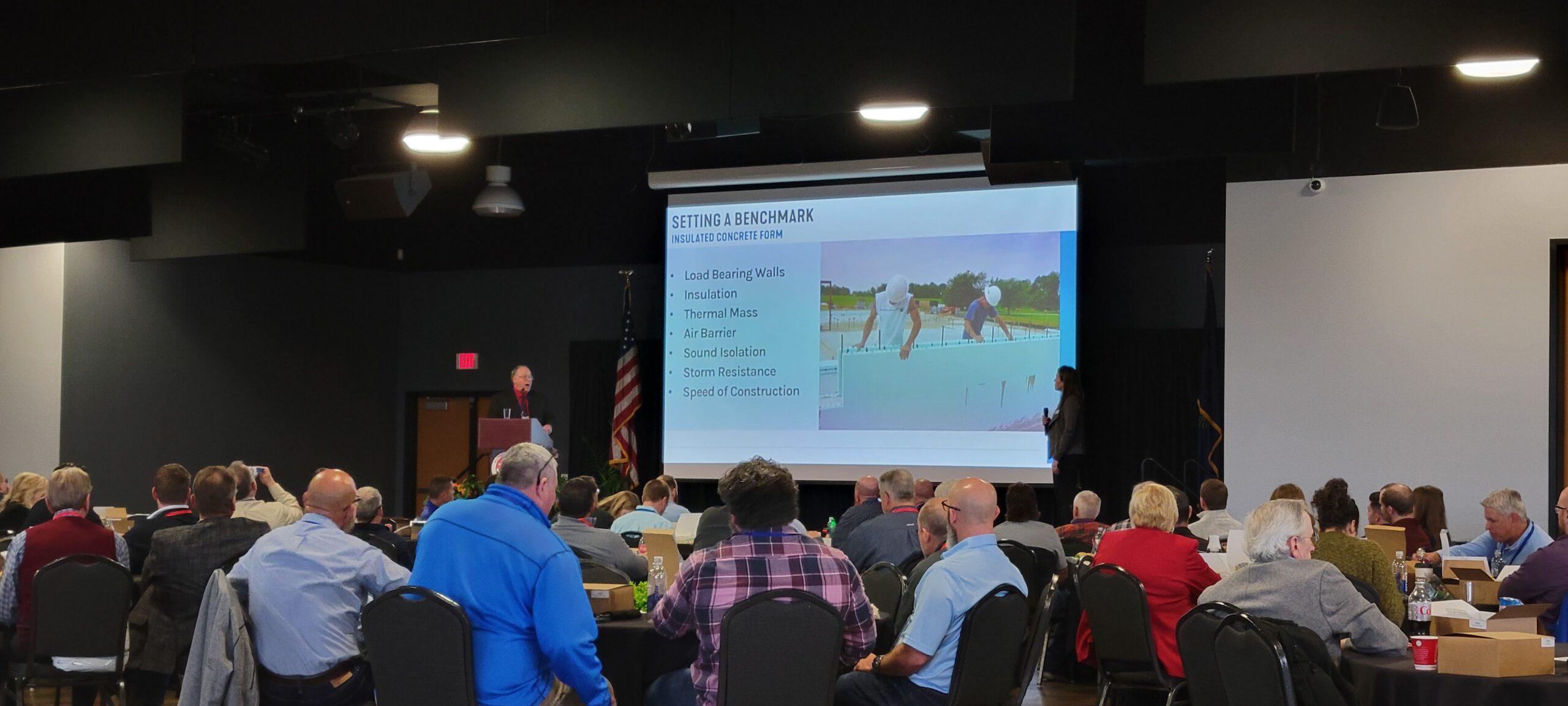
ICFMA Members Support NRMCA Build With Strength Future Schools Summit by D.C. Mangimelli, Business Development Advisor – Fox Blocks The ICFMA and several member companies participated in the recent Future Schools Summit, a resilient and high-performance schools symposium held at the National Corvette Museum in Bowling Green, Kentucky. This successful three-day event was held November 1st-3rd, 2022, and was organized by the National Ready Mixed Concrete Association (NRMCA), Build with Strength (BWS) coalition. The audience included; architects, design professionals, civil and structural engineers, school board members, general contractors, building envelope professionals, mechanical engineers, and several state NRMCA representatives. All desired to learn more and share experiences about the holistic approach of Net Zero Energy (NZE) or near NZE school buildings. These buildings are constructed utilizing updated modern building components like ICF as the basis of design for the building envelope. When discussing the many features and benefits that ICFs provide for school buildings, the speakers shared common experiences. Including First cost savings; cost performance when evaluated against Steel Frame or CMU; reduced construction timelines, long-term maintenance cost savings, extreme energy efficiency lowering utility costs; high sound attenuation (quieter) creating a less distracting learning environment; and increased life, safety and security [...]

By |2022-12-28T15:07:54-06:00December 28, 2022|Miscellaneous|
Go to Top